[A note from MeanMesa: The blog has been off line for a few days, and an explanation might be necessary. The first news is NEW GLASSES! After eye surgery a few weeks back the old glasses had become a constant irritation, but the new ones are super! The second news is that MeanMesa has been working on a "project." Although this is not a classified product, its publication is constrained by a temporary confidentiality/proprietary agreement. That will be over in a few weeks, and when that day arrives, the whole thing will be posted here on the blog.]
Who's Left the Zoo Unlocked?
Where have these people been hiding?
A rather frightening collection of quite reactionary types seems to have emerged while the attention of Americans has been focused elsewhere. Interestingly, they have also emerged all across the existing class structure in the country with representative components strewn from the very richest to the most desperately poor demographics. Likewise, the usual disparity arising from widely varying levels of intelligence hasn't seemed to exert any particular "segregating influence" on the mob, either. Those at the very top clearly demonstrate a significant capacity to design and execute mischief while those perpetually eager ones at the very bottom are apparently unable to discern much at all.
The result is a quite unanticipated congruence of "political types" with very little in common beyond the obvious scheme currently unfolding.
The GOP's Striking Penchant for
Whispering "Sweet Ideological Nothings"
By both the "passers" and the "receivers" -
and "passing" for "political discourse" in 2015.
Since it is now only a year and several months prior to the 2016 election, hundreds or thousands of "career oriented" broadcasters are already packing the air waves with amateurish, right wing political announcements, pronouncements, proclamations and other breathless, high wattage detritus. So much electrical energy is being dedicated to this purpose that one not familiar with the vacuous nature of the quadrennial electoral pageant might expect "some real substance" to be perched innocuously somewhere in all this blather.
 |
| Not romantic enough? [image] |
Of course visitors to this blog probably would never expect anything remotely like this, yet being "well informed" politically includes garnering a robust familiarity with the content of these "speeches" of theirs.
Here is the challenge.
Do a little sampling. MeanMesa's ROKU offers up a dozen or so of these "speeches" presented here and there with the "news" every night. Rather than simply "clicking" them into electronic oblivion in the nether reaches of hyper space, spend a minute listening to the Christies, Rubios, Trumps and the rest. While it's not particularly important [or healthy] to listen to exactly what they are saying, paying attention to the "general themes" of these carefully engineered conversational structures offers a starkly revelatory experience.
After consuming as much of this as is possible, you may very well conclude that these wing nuts are actually not talking about doing anything if elected. They no longer consider making campaign promises or out lining ambitious plans for the nation as worthy of the air time. Uttering or even hinting at such specific proposals have been defined as "quite risky" by the think tankers steering each candidate's media tactics from the back room, and, happily, so far as political promises go, the GOP base has now been so thoroughly numbed that they are no longer disposed to ever demand any.
For decades the American "conservative" movement has focused relentlessly on politics while avoiding making any "dangerous excursions" into actual policy or even promises of actual policy. In fact the priorities of paramount importance driving those in the super PAC think tanks seems to have almost nothing to do with the fate or direction of the nation, and, instead, has everything to do with manipulating the number of right wing voters who can be driven to the polls by the exquisitely crafted fears and outrages being presented in these very "speeches."
Although it must never be revealed to these "conservative" voters, there is, of course, an actual "conservative" policy. However, this carefully concealed "conservative" policy has a fatal flaw -- it will not deliver any election victories. No one in a "right mind" would ever think such a policy is even worth considering -- that is, except the billionaires who now officially own the Republican Party. They think finely honed, top secret, modern, "conservative," political policy of theirs is the "best thing since sliced bread."
For them, all that's left "to do" is to be very, very careful to never so much as mention this nasty, unsaleable, actual policy and, instead, direct billions of dollars worth of "campaign contributions" to selling something else to the GOP base. If that sale goes through, the oligarchs can simply "have at." That curiously interesting "something else" of theirs is, of course, the point of this post.
So, What ARE They Selling?
"Have another frozen ideology, Jimmy."
"Everything is swell."
Amazingly, even when things turn out unmistakably bad after a GOP "election victory," and these Congressional "servants of the oligarchs" are in power, no one who just voted for them complains! This is because, in such instances, things have turned out precisely as they promised in their campaign speeches! Plus, of course, the think tankers have also been working diligently all along to also establish someone to blame -- and, of course, that would be "someone else" to blame.
The romantic potential of all this "frothy, ideological nothingness" has begun to sour as it encountered its inevitable competitor for the attention of the GOP base:
PAIN.
The pain of existing in a continuously degrading economic reality will, given time, rise up to deflate this soap bubble, and we may be seeing the first fractures in this artificial racket unfolding right now. A comatose, paralytic, sold out Congress operating in a billion dollar echo chamber with the single intention of servicing the needs of its owners in the oligarch class doesn't help convince even this base that what is happening is actually somehow real.
While there's no real prospect of even imagining what the "bubble's collapse" will ultimately look like, the material consequences for Republicans are unavoidable.
A Closer Look at the Approaching Ice Berg
It is a mistake to presume that the shadowy clutch of insanely greedy, rapacious, democracy hating oligarchs is a new development. The oligarch class has been hard at work on achieving precisely this same outcome for decades. Much of the same inequality had been accomplished prior to FDR's time and the Great Republican Depression of 1929. During those times the obvious futility of the scheme was disguised below the palliative impression that everyone was making money on the market.
Well, everyone was making money on the market, but those at the top were REALLY making money on the market. When the quite predictable crash finally occurred, the disparity was reversed. Those at the top suffered a few scrapes and bruises, but everyone else REALLY lost their shorts on the market.
This time around the oligarchs did not find it necessary to divert the enticement of market advances to anyone except themselves. The population could be brought along quite nicely -- and quite cheaply -- with an unending stream of ideological fear mongering, artificial villains and irritating, fully funded, media chest beating.
If the GOP has thoroughly accomplished
one thing in the past 6 years, it's this.
SUN OCT 12, 2014
by Rachel191/Daily KOS
In six years of professional "No-ing," the GOP has accomplished very little. They've shut down the government, accused the president of trying to destroy the country, cooked up every sort of conspiracy theory you can imagine, attacked women, gays and minorities...but that really seems more like "activity" than something accomplished: petulant disagreeableness, throwing a wrench in the workings of the country because they're not in charge, and tearing down their scapegoats du jour.
But looking back at all Republicans have done, they seem to have achieved one goal really well: convince Americans making just enough that if only those with not enough had less, they'd be doing much better. Put another way, they've trained a certain segment of the population to kick downwards. Instead of looking at a system that makes it difficult to survive, instead of looking at the portion of the population that keeps getting richer and richer, instead of looking at how many hundreds and even thousands of times those above them make than everyone else...they look at the people just below them, getting poorer and poorer. Republicans have instilled such a level of contempt in people for unskilled laborers and the poor, that they do the work of justifying paying them less than enough to survive for the party.
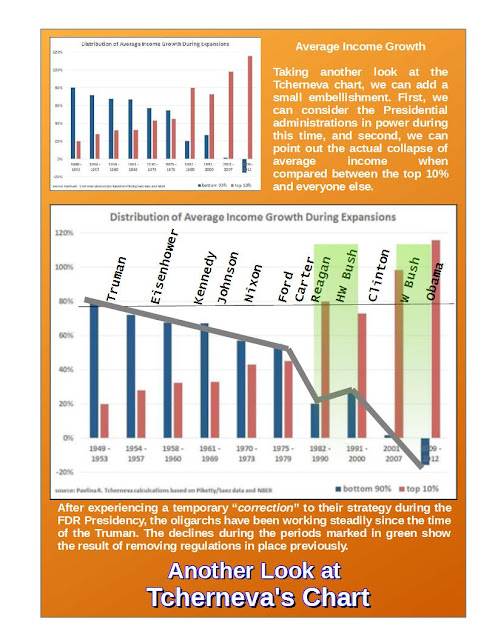
So, what exactly is the ultimate goal of this oligarch class strategy which must never be shared publicly with the GOP base? Have a look.
“The most important chart about the
American economy
you'll see this year”
FRI SEP 26, 2014
by Bob Swern/Daily KOS
I was doing my usual perusal of news and commentary throughout the blogosphere, earlier on Thursday, and I came across this quite stunning chart (see below) from Bard College and Levy Institute economist Pavlina Tcherneva.
Pavlina Tcherneva's chart showing the distribution of income gains during periods of economic expansion is burning up the economics internet over the past 24 hours and for good reason. The trend it depicts is shocking:
 |
| Emphasizing the Painfully Obvious [graphic MeanMesa] |
Yglesias continues…
For a long time, most of the gains from economic growth went to the bottom 90 percent of the income distribution. And, after all, the bottom 90 percent includes the vast majority of people. Since 1980, that hasn't been the case. And for the first several years of the current expansion, the bottom 90 percent saw inflation-adjusted incomes continue to fall.
The data series ends in 2012 and we don't know how long the expansion will last, so that negative income trend may evaporate before all is said and done. But unless there's a massive break with the previous three expansions we will continue to have an economy where the typical family's living standards grow much more slowly than GDP growth per se would allow.
The Narcotic Appetite for the Simple Stuff
From the "Good Ole' Days"
The mass appeal of ideology, absolutes and autocracy --
"piping hot," cheap and delicious!
[A little o' thet ol' rugged Bible don't hurt, neither...]
But not painless.
Because 30% to 40% of the American electorate has "chosen" to be swayed by this otherwise blatantly ridiculous rhetoric it may make sense to look at the phenomenon a little more closely.
A human with a relatively "average" capacity to consider propositions allows the persuasive weight of the data supporting them to be a main part of the process, yet, we see literally millions of Americans progressing through a very different kind of consideration when we look at the behavior of these GOP - neo-conservative base voters. Rather than taking this more or less rational approach to the formation of their individual "beliefs," this demographic seems strangely willing to either "set aside" or even completely avoid factual data's role in the process.
Yes, they tend to be severely "information challenged," but even more strikingly, they seem to also be quite seriously "curiosity challenged." Hopefully, we can assume that an autonomous individual would be interested in whether or not the "factual data" set driving his conclusions [about all sorts of things] would have an "individualized interest" in determining the credibility of that data set.
For example, various ancient religions tacitly accepted the idea that a giant turtle was drawing the sun from horizon to horizon each day. Although we have no particular means of determining whether or not individuals of the time took this seriously -- i.e. as credible data -- the sheer longevity of the myth's duration suggests that, in fact, many of them must have. There was, at the time, scant information contradicting such a proposal which might have led to serious skepticism about its reasonableness.
Earlier, the term "chosen" was presented.
The importance of these political decisions made by the GOP's base is well established. Even they understand that their votes actually manifest future consequences in very tangible way. Further, there is no externally enforced prohibition to gathering vast amounts of the easily available "data set" which would normally drive the conclusions they were making. It may even be added that this voting demographic probably has at least an average measure of functional capacity for normal curiosity.
[The GOOGLE has long ago penetrated all socioeconomic barriers to having a presence in every trailer park and American Legion beer halls across the country.]
So, why have these voters "chosen" to disregard the highly available data sets which might have possibly pulled the process for the formation of their opinions closer to rationality? Right here, we have brushed an arcane kind of explanation -- one of MeanMesa's frequently cited favorites.
Codependency.
The attraction on the part of these "voters in a Democracy" toward such a self-defeating form of "political considering" is, indeed, quite abnormal. In fact, it is so seriously abnormal that it more or less demands an explanation, and that explanation will not only fill the hypothetical academic needs arising from the normal curiosity about such things in the minds of researchers of this topic, it is also urgently necessary for the long term survival of a rational "representative" part of the US system.
Can the unusual political behavior of the conservative base voters be explained as a symptom of codependency? Unhappily, yes.
The right wing think tankers considered the codependency so rampant in their base to be an unexploited treasure trove in terms of manipulating these voters and, ultimately, the election outcomes they were being paid handsomely to produce. If it weren't so impersonal and sinister, one might consider it a "thing of beauty," but those being maneuvered by the scheme are also paying with their fair share of pain.
Their suffering is constantly sustained as they receive a precisely designed collection of stimuli from their closed media which more or less continuously incites their un-examined fears and literally drives them to all sorts of incendiary states. We see ample evidence of this at Tea Party rallies. The attendees are so violently angered as a result of this echo chamber narrative that their behavior, while almost comical, is also certainly tragic.
More reasonable people might worry about the health of these mentally impaired types, but the think tankers pulling their puppet strings are more than comfortable with the idea of simply sacrificing them to accomplish their contracted political ends.
We can revisit the title of this post.
Oligarchs
Autocrats
Ideologues
How can the reactionary right wing voter become so complacent with such creatures? The codependency idea offers one explanation.
Oligarchs:
This may be the easiest of the three. Right wing propaganda promotes the impossible rise of the typical tea bagger to "millionaire status" or beyond as an essentially inevitable outcome once those to blame for holding the economy in check have been subjugated. The "blame crowd" includes poor people, old people, minorities, college students and so on.
According to the reactionary propaganda, these are exactly the Americans who are continuously "hollowing out" the nation's prosperity at the expense of all those who would have almost automatically prospered otherwise. Of course, this amounts to little more than "frog feathers" in the light of day, but given enough saturation by hate radio, these codependent Republican voters predictably begin to see themselves as victims.
There is a prescient anecdote [not MeanMesa's] which describes a tea bag's view of his own situation as that of a "temporarily embarrassed millionaire."
Codependents are obsessed with control, and these codependents are convinced that if these "moochers" were to just be controlled, financial success for them would follow in basically an inevitable, spontaneous explosion in a few days. The rhetorical narrative of right wing propaganda implies that supporting reactionary candidates is the equivalent of, once again, reestablishing this control.
Perhaps the most egregious of the obviously false premises contained in the fundamentals of such propaganda is that, at some previous time, control of this type had fostered a wide spread, well balanced prosperity.
Autocrats:
Autocrats offer the codependent a special opportunity not really available elsewhere. In supporting an autocracy the individual task of forming opinions or proposals about how things "should" be run is removed. Things will be run as directed by the autocrat. So long as one supports the autocracy, one is relieved of the possibility of ever actually "being wrong." One is also relieved of the necessity of formulating ideas about potential alternatives to the autocratic "suggestions," "justifications" and arguments concerning "necessities."
The flow of reactionary propaganda is meant to accomplish many things, but in this respect its highest priority may be to simply portray the actions of the autocrat as being successful. The cause of any failures in the autocratic policy is laid at the feet of the dangerously out of step types, the carefully orchestrated "villains" in the milieu. The "villains" will never be defeated or neutralized, so the autocracy is perpetually excused and justified.
Those deserving credit and those deserving blame are provided to the codependent supporters of an autocracy as absolutes, unquestioned and unchanging. Everything is continuously under suffocating control. Meanwhile, there is only sacrifice -- always unfortunate and yet always also quite reasonable -- to be made, and no decisions to ever be taken.
Ideologues:
When political discourse can be entirely translated into questions of ideology, demands become theoretical. When the promises are devoid of details, the demands, in time, inevitably follow suit becoming cloudy generalities under which the success or failure of policy must be "debated."
However, because codependents detest confrontation, these "debates" resolve nothing while placing those "debating" into one inexorably comfortable ideology or another. "Debate positions" become the equivalent of uniforms identifying in which of the opposing armies one is enlisted. Any possible solutions are comfortably obscured by the fog of "true belief."
Individual responsibilities for any disagreements arising is transferred to the ideology -- at least to the individuals in charge of expressing it. We see examples of this in the doggerel maxims paraded so proudly in right wing demonstrations such as those televised during the attempt to recall Scott Walker.
The codependent individual is shielded from the necessity of ever creating or holding an actual position as an individual in favor of parroting the position of the ideology. When there is an actual confrontation between two parties, the ideologue can transfer "the heat" to a third, invisible character -- the ideology. When this occurs, the ideologue begins citing talking points as irrefutable fact, and the discussion is soon finished.
Aside from the obvious task of manipulating the reactionary GOP base in this way, the think tankers have not neglected the remainder of voters in the process. By reducing the once strong prospect of voters that their votes mattered to the modern alternative where that opinion has turned to the contrary, the old hope which used to inspire the process has been converted to hopeless futility.
The old Chinese proverb may be quite on point here.
"There are three emotions in the life of man -- love, hate and apathy. Of the three, apathy is the strongest."
Calling the 38% voter turn out in the 2014 election "apathy" may be off target. If it were truly the result of "apathy," we would not find ourselves so worried about it. Perhaps we will be more accurate to call it a carefully engineered disgust.


